

- Télécharger en PDF
-
Partager cette page
- Télécharger en PDF
Conference : Futures of Education for Peace, June 19th 2026
A Dialogue Centric Conference about the role of Education and Futures Studies in the Pursuit of Non-violent Futures
le 19 juin 2026
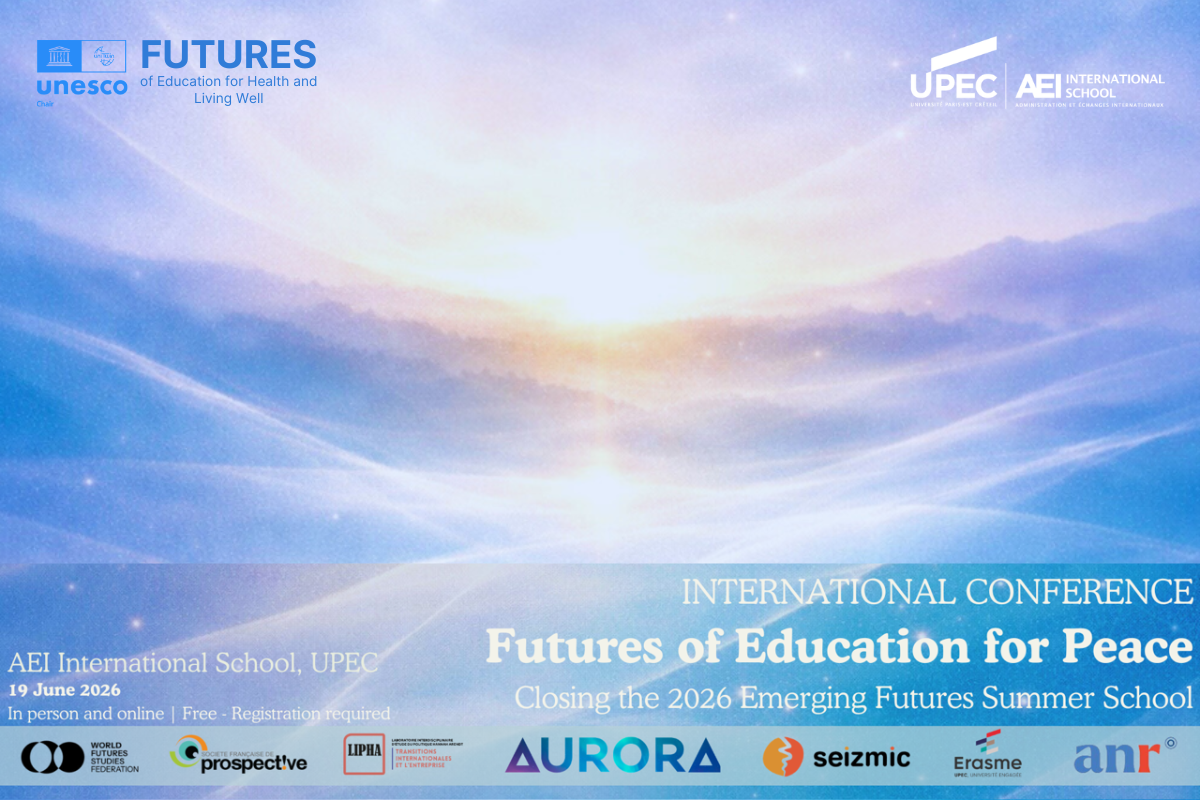
Hosted by the UNESCO Chair on the Futures of Education for Health and Living Well at AEI International School (Université Paris-Est Créteil, UPEC)
Provisional Progam
9:00 Welcome Coffee & Pastries
9:30 Opening Remarks
9:45 Roundtable Futures of Education with :Sobhi TAWIL, Tanja HICHERT, Hughes MOUSSY, Riel MILLER, and Peter JEDNASEZWSKI
11:15 Break
11:30 Roundtable Research and Practice for Non-Violent Futures with :Laura Lema SILVA, Ivana MILOJEVIC, Keil EGGERS
13:00 Lunch
14:30 Roundtable Anticipatory Governance and Coalitions for Peace with :Antje BIERWISCH, Carine DARTIGUEPEYROU, Catherine RHODES, Clare STARK, and Angela HANSON
16:00 Reflections & Questions
16:15 Summary of Themes & Closing by Fabienne GOUX-BAUDIMENT
16:45 Certificates Delivery for the Summer School Students
17:00 Cocktail Reception
Dialogue first
The format is built for interaction: short provocations, moderated round tables, and semi-structured exchange. April K WARD, PhD whose research focuses on imagined futures and anticipation embedded in the landscape of conflict and peace, will be Master of Ceremonies and moderate the tables, ensuring continuity across themes and helping translate insights into shared questions and next steps. The event invites participants to work through three tensions:
Peace as aspiration or as practiced capability: what can be taught, learned, and sustained over time? What is the connection between visions of peace and practice?
Peaceful futures through curricula and pedagogy or infrastructures and institutions: what makes peace education possible at scale? What systems could favour non-violent norms?
Conflict outcomes framed through short-term pressures or long horizons: how can education avoid fear-based futures while strengthening responsible agency? What are the outcomes of conflict and violent conflict, when focused on a shorter or longer horizon?
Roundtables
Futures of Education Convening UNESCO Chairholders and European Training Foundation representatives to examine how futures-oriented education is framed and put into practice, and how peace, cohesion, and inclusion are addressed across contexts. With :
- Sobhi TAWIL (Director, Future of Learning and Innovation Team, UNESCO)
- Hugues MOUSSY (Head of Unit, HCD Intelligence Unit, European Training Foundation)
- Tanja HICHERT (UNESCO Co-Chair in Complex Systems and Transformative African Futures)
- Riel MILLER (Futures Literacy)
- Peter JEDNASEZWSKI (Saint Mary Institute)
Research and Practice for Non-Violent Futures Grounding the discussion about how research can support non-violent futures, and what sort of practices could promote conflict resolution and cultures of peace (infrastructures needed to educate for peace, pedagogical architectures, partnerships, evaluation criteria, etc). With :
- Laura Lema SILVA (Institut pour la Paix, Université Paris-Est Créteil)
- Ivana MILOJEVIĆ (Director, Metafuture)
- Keil EGGERS (Researcher, Us Against When)
Anticipatory Governance and Coalitions for Peace UNESCO’s futures and foresight teams together with the Société Française de Prospective, extending the horizon toward anticipatory governance and societal capacities for cooperation, including discussions of UNESCO’s Global Anticipatory Policy Coalition (led by UNESCO’s MOST Programme) providing additional context for the exchange. With :
- Angela HANSON (Lead of Anticipatory Innovation Governance, OECD Public Governance Directorate)
- Antje BIERWISCH (UNESCO Chair in Futures Capability for Innovation and Entrepreneurship, MCI University)
- Carine DARTIGUEPEYROU (Présidente, Société Française de la Prospective)
- Clare STARK (UNESCO Futures Literacy)
- Catherine RHODES (Centre for the Study of Existential Risk, Cambridge University)
Background
Futures of Education for Peace is an international, conversation-led conference closing the 2026 Emerging Futures Summer School, hosted by the UNESCO Chair on the Futures of Education for Health and Living Well at AEI International School, Université Paris-Est Créteil (UPEC).
In a context shaped by polarisation, violent conflict, and deep uncertainty, education is asked to play a wider role than knowledge transmission alone. This conference starts from a straightforward idea: peace is a capacity to build—it is learned, practiced, and sustained through relationships, institutions, and the infrastructures that make cooperation and constructive conflict resolution possible.
Education is regularly asked to “promote peace,” and the challenge is to move from intention to practice. This conference focuses on what it takes to build peace in real societies (with real conflicts and legitimate constraints) by shifting the discussion to capabilities and infrastructures: training, institutional design, governance arrangements, partnerships, civic ecosystems, and the anticipatory frames that shape decisions. Inspired by Elise M. Boulding’s emphasis on imagination and shared visions for peace, by Johan Galtung and Francis Hutchinson’s insistence on the importance of connecting education to peace imaginaries, and by insights developed in Futures Studies about how anticipation shapes action in the present.
There is growing interest in connecting Futures Studies to widen the range of peace-possibilities, surface assumptions, and act with greater responsibility in the present and for the future. The conference connects education, peacebuilding, and futures thinking around a shared question: how can learning systems strengthen peace as a capacity—individual, collective, and institutional—under conditions of accelerating change?
Three anchored dialogues will structure the discussions: the Futures of Education (with UNESCO and partners), Research and Practice for Non-violent Futures (with the Institut pour la Paix), and Anticipatory Governance and Coalitions for Peace (with the Société Française de Prospective and UNESCO’s MOST Programme on Futures Literacy and Foresight) informed by the background discussions of UNESCO’s Global Anticipatory Policy Coalition. Fabienne GOUX-BAUDIMENT will conclude with a synthesis capturing convergences, productive disagreements, and priority questions to carry forward beyond the event.
Who may be interested
- Universities and UNESCO Chairs: align futures-oriented education and futures thinking with peacebuilding capabilities and share approaches that can travel across contexts.
- Public institutions and international organisations: connect education and anticipatory policy with prevention, cohesion, and long-term resilience under uncertainty.
- Practitioners (mediation, youth, civic action): discuss, from a researchgrounded base, what infrastructures help reduce violence and strengthen cooperation.
- Foresight and futures literacy communities: bring anticipatory practices into a domain where institutional constraints and societal stakes are explicit and connect futures studies more explicitly with peacebuilding and conflict resolution.
How Register :
- IN PERSON (en présentiel) : https://forms.gle/BkSELNuYK8oupaVF6
- ONLINE (en ligne) : https://forms.gle/BDwJjGEv4Q9Bnqiz6

Program
CHECK THE program (.pdf)
- Télécharger en PDF
-
Partager cette page
- Télécharger en PDF