

- Télécharger en PDF
-
Partager cette page
- Télécharger en PDF
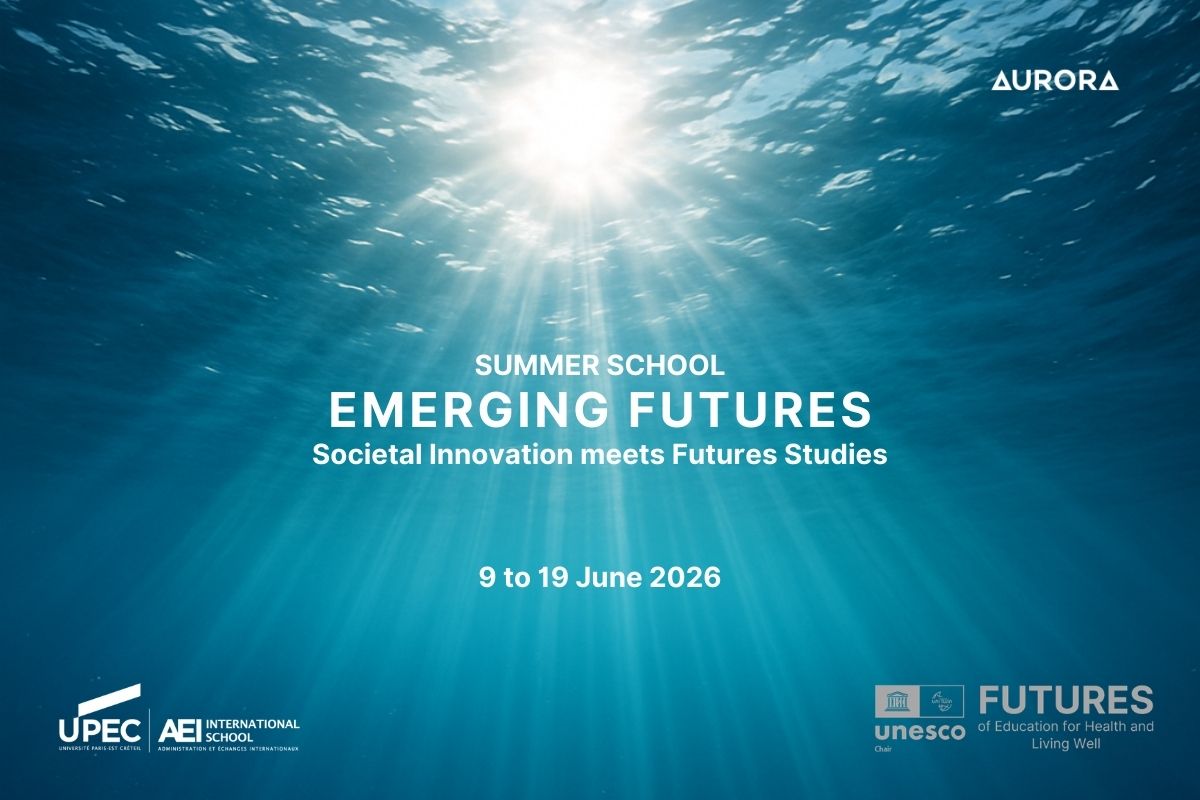
Emerging Futures Summer School 2026
Publié le 9 juin 2026
9 - 19 June 2026, Paris (UPEC -AEI International School), In English
Date(s)
du 9 juin 2026 au 19 juin 2026
Every year, we invite students and partners from across the Aurora alliance and beyond to spend ten days in Paris working on a shared question: how do we make decisions when the future no longer behaves like the past?
Emerging Futures is an intensive Summer School on Futures Studies, Strategic Foresight and Futures Literacy, organised by the UNESCO Chair on the Futures of Education for Peace and Living Well (UPEC–NOVA–Fiocruz) and hosted by AEI International School (Université Paris-Est Créteil, UPEC), within the Aurora European Universities Alliance. It blends rigorous thinking with hands-on practice—because futures work is not about predicting: it is about learning to see differently, together, and turning that into better choices.
This 2026 edition will conclude on 19 June with a dedicated international moment: the Futures of Education for Peace conference, welcoming guests and partners to explore how education can strengthen peace capacities in times of profound transition.
It is not a lecture series where you sit back and take notes. You will participate actively, test methods, compare perspectives, and learn how to communicate futures insights in a way that is useful for organisations and society.
You will also work with the core idea of Futures Literacy: using the future to understand the present differently—by surfacing assumptions, widening options, and discovering what we usually don’t see.
Along the way, we will explore and practice key approaches commonly used in professional foresight and futures research, including horizon scanning, scenario exploration, implications and options, and approaches connected to decision-making under deep uncertainty.
The Summer School ends with an international conference focused on how futures capabilities can contribute to peace: not as an abstract ideal, but as a concrete challenge for education systems, institutions, and societies facing polarisation, conflict risks, and accelerating change.
The programme will be available soon.
You can apply if you are:
AEI International School lecturers (indicative) :
How nominations work
Nominations must be submitted by email by the Aurora representative at the partner university to :
aeisummerschool@u-pec.fr
We strongly recommend including: the student’s full name, email, degree level/programme, and a short motivation (a few lines is enough).
Selection results : 7 April 2026
Student registrations (selected students) : until 16 April 2026
Because places are limited and the programme is intensive, we will actively work to reduce no-shows. If your student is selected, we ask for a clear confirmation of participation and completion of registration steps by the deadline.
Emerging Futures is an intensive Summer School on Futures Studies, Strategic Foresight and Futures Literacy, organised by the UNESCO Chair on the Futures of Education for Peace and Living Well (UPEC–NOVA–Fiocruz) and hosted by AEI International School (Université Paris-Est Créteil, UPEC), within the Aurora European Universities Alliance. It blends rigorous thinking with hands-on practice—because futures work is not about predicting: it is about learning to see differently, together, and turning that into better choices.
This 2026 edition will conclude on 19 June with a dedicated international moment: the Futures of Education for Peace conference, welcoming guests and partners to explore how education can strengthen peace capacities in times of profound transition.
What this Summer School is (and isn’t)
Emerging Futures is designed for people who want to go beyond headlines and trends, and learn how to work with uncertainty in a disciplined way. You will be introduced to the foundations of futures thinking and then immediately put them to work in labs, simulations and group exercises.It is not a lecture series where you sit back and take notes. You will participate actively, test methods, compare perspectives, and learn how to communicate futures insights in a way that is useful for organisations and society.
What you will learn and practice
Across the programme, participants progressively build a shared toolbox. You will learn how to notice weak signals without overreacting to noise, how to frame uncertainty without getting stuck, and how to explore alternative futures without turning them into predictions.You will also work with the core idea of Futures Literacy: using the future to understand the present differently—by surfacing assumptions, widening options, and discovering what we usually don’t see.
Along the way, we will explore and practice key approaches commonly used in professional foresight and futures research, including horizon scanning, scenario exploration, implications and options, and approaches connected to decision-making under deep uncertainty.
A special highlight: a Game on the Great Transitions
In 2026, Fabienne Goux-Baudiment will host a participatory Game on the Great Transitions—a facilitated simulation that helps participants experience complex transition dynamics firsthand. It’s an engaging way to explore trade-offs, path dependencies, and strategic dilemmas, and to reflect together on what “transition” really asks of us.International Conference – 19 June 2026
Futures of Education for PeaceThe Summer School ends with an international conference focused on how futures capabilities can contribute to peace: not as an abstract ideal, but as a concrete challenge for education systems, institutions, and societies facing polarisation, conflict risks, and accelerating change.
The programme will be available soon.
Who is it for?
The Summer School welcomes a diverse cohort. Participants often come from management, social sciences, public policy, sustainability, education, international relations, innovation, engineering, design—and sometimes from fields that are not “futures” at all. That diversity is a strength: futures work improves when people bring different lenses to the same uncertainty.You can apply if you are:
- a student (3rd year BA or 1st year MA) curious about futures methods and how they connect to real-world decisions, or
Teaching team (indicative)
The programme is delivered by an international team of lecturers and facilitators, hosted by AEI International School.AEI International School lecturers (indicative) :
- Felipe Koch (AEI / UPEC), on Futures Literacy
- Philippe Frouté (AEI / UPEC), on Forecasting
- Anika Keils (AEI / UPEC) on Strategic Foresight.
- Ramon Rispoli, from the University of Naples, will host a lecture/ workshop on Transition and Speculative Design
- Rocco Scolozzi, from the University of Trento, will teach a course on Systems Thinking
- Fabienne Goux-Baudiment, from Progective, will run a game on the Great Transition
- Fabio Scarano, curator of Rio's Museum of Tomorrow, will teach a course onRegenerative Futures
- Riel Miller, former head of Futures Literacy at UNESCO, will host a lecture/workshop on Anticipatory Systems and Processes
Aurora partners: nomination required
If you are applying through an Aurora partner university, you must be nominated by your home institution.How nominations work
Nominations must be submitted by email by the Aurora representative at the partner university to :
aeisummerschool@u-pec.fr
We strongly recommend including: the student’s full name, email, degree level/programme, and a short motivation (a few lines is enough).
Key dates (Aurora route)
Nomination deadline : 6 April 2026Selection results : 7 April 2026
Student registrations (selected students) : until 16 April 2026
Fees and commitment (important)
For selected participants, AEI International School will cover the registration fees.Because places are limited and the programme is intensive, we will actively work to reduce no-shows. If your student is selected, we ask for a clear confirmation of participation and completion of registration steps by the deadline.
- Télécharger en PDF
-
Partager cette page
- Télécharger en PDF